
China: Aldi’s Acceleration vs. Local Innovation

As of March 2026, the Chinese retail market has hit a critical inflection point. While traditional hypermarkets contract, a new "Quality-Price Ratio" era has emerged, defined by Aldi's aggressive "hard discount" blitz and local retailers’ tech-driven defense.
1. The Aldi "Slam on the Accelerator"
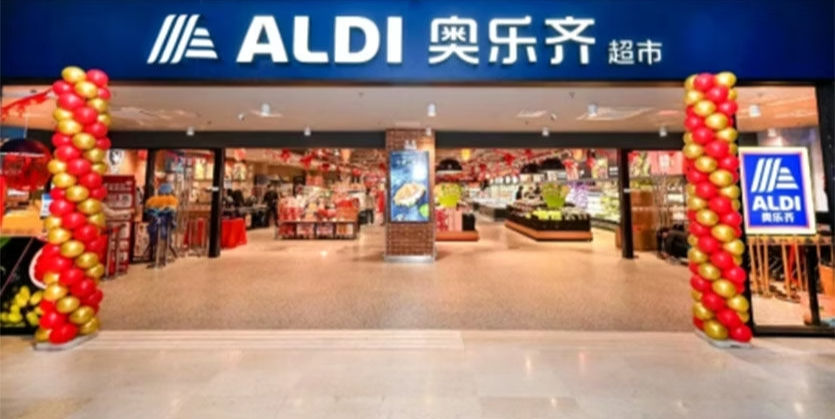
After taking nearly seven years to reach its 100th store in China, Aldi has suddenly pivoted to a high-speed growth phase.
The 2026 Goal: Aldi plans to add over 50 new stores within this year alone—amounting to half of its total growth from the previous seven years.
Geographic Expansion: The footprint is rapidly moving beyond Shanghai into Suzhou, Wuxi, Nanjing, and Zhenjiang, targeting core business districts and high-density residential communities.
Efficiency Metrics: Standard stores (500–1,000 $m2) operate with just 8–10 employees, with labor costs accounting for only 4% of sales.
2. Radical Efficiency: The "Hard Discount" Model
Aldi’s surge is built on a foundation of extreme operational discipline:
The 90% Private Label Moat: Nine out of ten items on Aldi’s shelves are private brands. By cutting out distributors and agents, they pass all middleman savings directly to the consumer.
SKU Simplicity: Aldi maintains only about 1,000–1,300 SKUs—roughly one-tenth that of a traditional supermarket. This eliminates "analysis paralysis" and ensures massive bargaining leverage with suppliers.
Cut-Case Displays: Products are displayed in their shipping cardboard boxes, drastically reducing the labor hours required for stocking shelves.
3. The Secret Weapon: Instant Retail (O2O)
In a market where digital integration is mandatory, Aldi has outperformed local peers in the "online-to-offline" space.
Top-Tier Online Penetration: Online delivery orders now account for over one-third of total sales. Most local supermarkets struggle to exceed 15%.
The 20% Margin "Sweet Spot": By controlling 90% of its products, Aldi maintains a gross margin of roughly 20%. This provides enough "padding" to cover the fulfillment costs of last-mile delivery, a feat low-margin discounters (at 15%) find difficult to achieve.
Front-end Warehousing: Aldi’s community-centric locations act as natural micro-fulfillment centers, keeping the delivery radius short and turnover high.
4. The Local Response: Beyond "Copying"
Local giants like Wumart are proving that the answer isn't just to mimic Aldi, but to evolve.
The Hybrid Approach: Wumart launched "Wumart Value" discount stores with slashed SKUs and 60% private labels, but combined them with a different "track."
AI New Quality Retail: In March 2025, Wumart’s Xueqing Road store renovation used AI to boost daily offline sales by 2.5x.
Livelihood Assurance: Unlike Aldi’s standardized efficiency, Wumart positions itself as a "community pillar," handling government-linked livelihood supplies—a role that is difficult for a foreign standardized model to replicate.
5. Market Outlook: The Risks of Speeding
Despite the momentum, the "China Gamble" faces significant hurdles in late 2026:
The Logistics Stretch: As Aldi moves into Zhejiang and Anhui, the delivery radius from their Shanghai-centric supply chain drastically increases. Early signs of strain, such as empty bakery shelves by 5 PM, suggest that 24-hour replenishment may be difficult to maintain in secondary cities.
Consumption Habits: Success in affluent Shanghai/Suzhou does not guarantee victory in Anhui or inland provinces, where the "mid-range discount" positioning may face "high-and-low" pressure from both premium clubs and ultra-budget local chains.
Final Thoughts: A Diverse Ecosystem
The retail war of 2026 is no longer a "one-man show." China’s vast market is currently accommodating multiple successful tracks:
Aldi: Pursuing efficiency, standardization, and digital synergy.
Wumart: Pursuing AI-driven scale and community-based livelihood support.
The Consumer: Pursuing the best "Quality-Price Ratio" rather than absolute low price.
The ultimate winners will not be those who are simply the cheapest, but those who best understand the shifting needs of the Chinese consumer in the post-hypermarket era.


Comments