
China: Traditional Retailers Struggle to Adapt to the New Market Environment

The retail industry is undergoing a moment of "qualitative change" in China. Retailers such as Costco, Pinduoduo, Aldi, Pangdonglai and Ling shi Hen Mang (Snacks Busy) have risen rapidly through aggressive price advantages, carving up the market share of traditional supermarkets and even traditional e-commerce. As a result, declining performance, store closures, and bankruptcies have become the "new normal" in the retail track.
In recent years, Snacks Busy opened 2,000 stores in a short period, with annual sales exceeding 6 billion RMB. Mixue Bingcheng took only a little over a year to leap from 10,000 to 20,000 stores, a milestone that previously took them 20 years to reach. Luckin Coffee used 10-RMB price points to swiftly disrupt the coffee market dominated by Starbucks. Consumers have used their wallets to prove the irresistible pull of low prices.
Simultaneously, these emerging companies are restructuring supply chains and operating systems. By providing low-cost, low-price goods, they are forcing the entire industry to transform. This year, Taobao and JD.com reaffirmed their low-price strategies, sparking a new "price war." Compressing costs has become a consensus for traditional supermarkets, while others have begun pivoting to discount store formats.
We have enough reason to judge that the Chinese retail industry has entered a "Low-Price Era." "Extreme cost-performance" and "high volume, low margin" have become the true rules of survival. Historically, global experience proves that economic downturns birth low-price retail formats, Walmart and Uniqlo are both products of such environments.
However, "low-price retail" differs from simple price-cutting. Its essence lies in establishing a sustainable low-cost operating system, the result of process optimization and efficiency gains.
This has sparked two major debates:
Authenticity: Do domestic discount and snack stores represent true low-price retail? Some argue their low prices come at the expense of quality, or are fueled by capital-driven growth at a loss.
Survival: Can traditional retailers grow through reform? Most insiders believe it is theoretically possible but practically difficult. Traditional models have fixed mechanisms that are hard to change fundamentally.
The Golden Age
The conditions for low-price retail in China have matured. Professor Chen Liping of Capital University of Economics and Business notes that economic downturns often drive industry revolutions. The supermarket format and Walmart were born from US economic crises; Uniqlo and "Business Supermarkets" emerged after Japan’s growth stagnated in 1995.
As consumer spending power and willingness decline, new players with "low cost, low margin, and low price" quickly capture the consumer mindshare. Post-pandemic economic pressure has led consumers to be more rational and price-sensitive.
Crucially, reduced spending isn't necessarily "consumption downgrading"; consumers still want quality, just at a lower price. This is supported by:
Manufacturing Maturity: Domestic factories can now provide high-quality, cost-effective products.
Direct Marketing: Social media and self-media have lowered the cost of brand awareness. Consumers realize that "White Label" (unbranded private label) goods often come from the same factories as Tier-1 brands, and they are no longer willing to pay the "brand premium."
The Revolutionaries
Since 2020, price-advantaged retailers have exploded. Douyin E-commerce jumped from 10 billion to 1 trillion RMB in scale. Community group buying now reaches 900 million users. In brick-and-mortar, discount formats are booming.
Innovation is cannibalizing traditional profit centers. In Changsha, snack stores have replaced supermarkets as the primary channel for milk, outselling them five to one.
True low-price retail is defined by the system, not just the price tag:
Costco: Profit comes from membership fees, allowing them to keep product margins incredibly low.
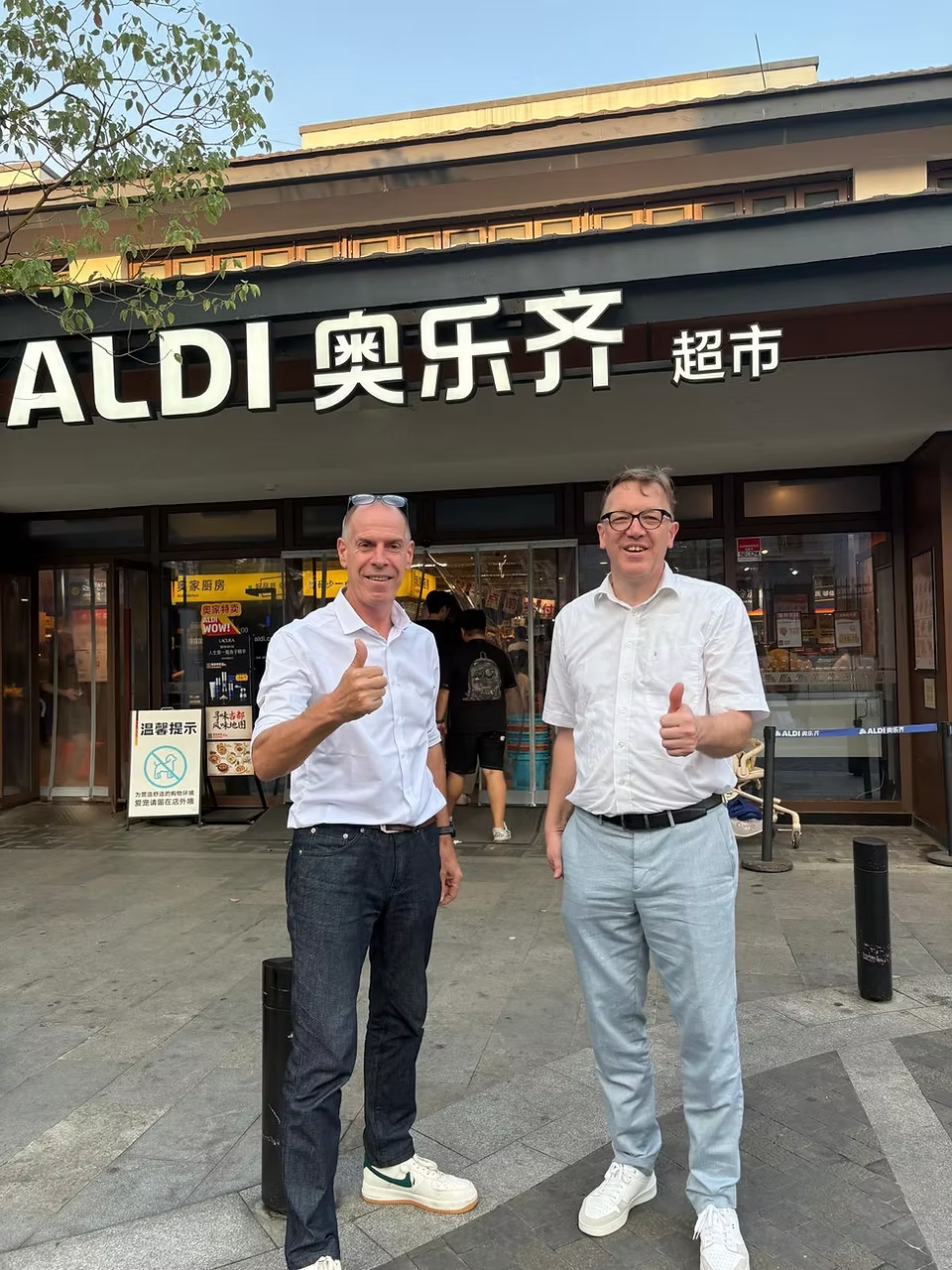
Aldi (and similar Chinese discount stores e.g. Ottno, NB, FD, HappyMonkey): They lower costs through cash purchases (avoiding debt cycles), private labels, and "Explosive Product" logic (fewer SKUs, higher volume).
Operational Efficiency: Using "cut-case" displays (no stocking shelves), forklifts in-store, and coin-operated carts to reduce labor costs. Successful discount stores keep rent and labor at 3% – 5% each, achieving a 3%–5% net profit on only 15% gross margin. Traditional supermarkets usually require 20% gross margin to survive.
The Way Out
In a loose competitive environment, traditional Chinese retailers didn't make much progress in efficiency. In contrast, Japanese retailers spent 30 years refining global supply chains, for example, growing fruit in Africa to control the cost of 100% apple juice to around 5 RMB per liter.
The future of Chinese retail is trending toward:
Extreme Cost-Performance: This becomes the primary competitive direction.
Fragmentation: After hypermarkets close, the market will split. High-frequency goods will move to professional community stores (fresh food, deli), while low-frequency goods move to malls (Miniso, HotMaxx).
Conclusion
The low-price era is not the home turf of traditional retailers. The shift from "earning from suppliers" to "earning from products," and from "credit terms" to "cash purchases," requires a total overhaul of organizational structure and incentives. For most traditional retail giants, the "ship is too big to turn," making it difficult to adapt to this new environment in China.

#smartdiscount #aldi #discount #china #growth #privatelabel #costco #Pinduoduo #Pangdonglai #LingshiHenMang #competition #price #drc #discount #retail #consulting #discountretail #discountretailconsulting #retailconsulting #harddiscount #hd #google #twitter #efficiency #lowprice #efficiency #lowcost #capitaluniversity #jdcom #alibaba #meithuan #pupumart #ottno #miniso #hotmaxx #pandonglai


Comments