
China: Why Hard Discount Is Becoming the Life-or-Death Anchor for Commercial Malls

Across global markets—and with striking velocity in China—a structural shift is underway in commercial real estate: shopping malls are aggressively evicting legacy hypermarket anchors and replacing them with hard discounters and high-velocity value formats.
The map is being redrawn. Legacy hypermarkets like Yonghui, Sun Art Retail (RT-Mart), and Walmart are scaling back or exiting prime basement locations, while hard discount formats — led by international heavyweights like Aldi and native disruptors like Chaohesuan NB (Hema’s discount arm) and Meituan’s Happy Monkey — are sweeping in to take their place.
The physical real estate hasn't moved, but the underlying anchor mechanics have fundamentally shifted toward discount retail efficiency.
1. The Anchor Paradox: Why Mall Economics Depend on Discount Grocery
To understand why mall developers are pivoting toward discount retail, we must examine the mechanics of commercial foot traffic.
Unlike seasonal apparel or peak-hour dining, grocery retail functions as a year-round, high-frequency utility. A 1,000 to 3,000 m² grocery anchor pulls thousands of recurring visitors weekly, providing the essential "traffic engine" that feeds surrounding mall tenants.

Source: Gemini AI supported
When a legacy hypermarket fails, the entire property cools down. However, replacing it with another bloated, broad-assortment supermarket no longer works. Modern consumers demand value certainty. When developers swap legacy anchors for hard discount formats, customer visits and cross-category retail sales rebound rapidly because the new tenant provides an unassailable reason to visit offline.
2. From "Shelf-Space Sub-Lessor" to "Lean Supply Chain Engine"
Why are legacy hypermarkets failing on the exact same footprints where hard discounters thrive? It comes down to a structural clash in unit economics.
Operational Metric | Legacy Hypermarket Model (e.g., Yonghui, Traditional Walmart) | Hard Discount Model (e.g., Aldi, Chaohesuan NB, Happy Monkey) |
Footprint & SKUs | 10,000+ m² / 20,000+ SKUs | 500–1,500 m² / 1,500–3,000 SKUs |
Revenue Model | Vendor slotting fees, listing charges, shelf leasing | Product margin spread, rapid stock-turns, low shrinkage |
Merchandise Mix | High third-party national brand density | High private-label ratio (60% to 90%+ in-house brands) |
Operating Efficiency | High labor cost, complex displays, slow inventory turn | Pallet-ready displays, ultra-lean staffing, high density per m² |
Traffic Vulnerability | High—Siphoned by e-commerce and price-comparison tools | Low—Protected by proprietary items and EDLP (Everyday Low Price) |
Legacy hypermarkets operated primarily as real estate sub-lessors, relying on slotting fees paid by consumer brands to cover massive sales floors. As e-commerce siphoned off volume, those bloated leases became unsustainable.
Hard discounters, by contrast, act as vertically integrated brand owners disguised as retailers. By capping SKUs, driving private-label penetration above 60%, and using simplified in-store logistics (pallet-ready packaging, minimal display work), discounters achieve structural cost advantages that allow them to offer unmatchable price points while generating strong returns per square meter.
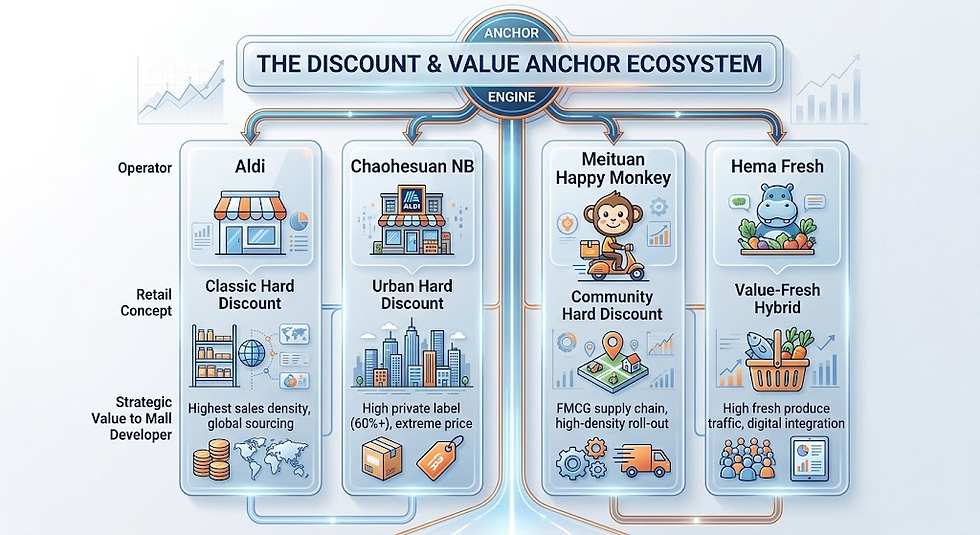
3. The New Anchor Hierarchy: How Malls Are Selecting Discount Partners
Commercial leasing directors are no longer looking for brand heritage; they are evaluating operating models built for modern value-seeking consumers.
Source: Gemini AI supported
Aldi: Operates tight, 500–1,000 m² footprints with under 3,000 SKUs (over 90% private label), achieving elite profitability per square meter through global sourcing scale and operational discipline.
Chaohesuan NB: Rapidly scaled past 550 stores by delivering price leadership through 800+ proprietary SKUs (e.g., 0.4 RMB bottled water, 0.7 RMB tofu). It converts price-sensitive, pragmatic households into high-frequency mall visitors.
Meituan Happy Monkey: A fast-growing community discount player leveraging tech supply chains, direct source buying, and ultra-lean store operations to open high-density locations in suburban and industrial trading areas.
4. Strategic Assessment: Hard Discount Is the Ultimate Traffic Guarantor
From a commercial leasing and asset management perspective, the criteria for selecting anchor tenants have permanently shifted:
Volume Over Footprint: Developers prefer 1,000 m² hard discounters over 10,000 m² hypermarkets. Smaller footprints yield higher sales per square meter and leave extra space for higher-margin specialty leasing.
Private-Label Margin Protection: Retailers with proprietary sourcing (60%+ private-label penetration) control their own margins and pricing, protecting them from price wars with online platforms.
Consumer Pragmatism as a Long-Term Trend: Value-seeking behavior is not a temporary trend; it is a permanent structural consumer shift. Discounters that take product selection off the customer's plate by offering curated, high-quality, low-cost essentials win long-term loyalty.



Comments