
China: "Poor-Guy Supermarket"—Aldi: Low Prices Are the Best Advertising!

Discount Retail Chain Aldi shows prices on the shelves that are almost unbelievably cheap. Toothpaste is 5.9 yuan, a 100ml cleanser is 9.9 yuan, a pack of sanitary pads is 3.9 yuan, a large tub of yogurt is just over 10 yuan, and a butter croissant is a little over 3 yuan each.
Someone holding a shopping basket picks up items while remarking, "This is way too cheap," before turning around to post on social media: This place is simply a "poor-guy paradise."
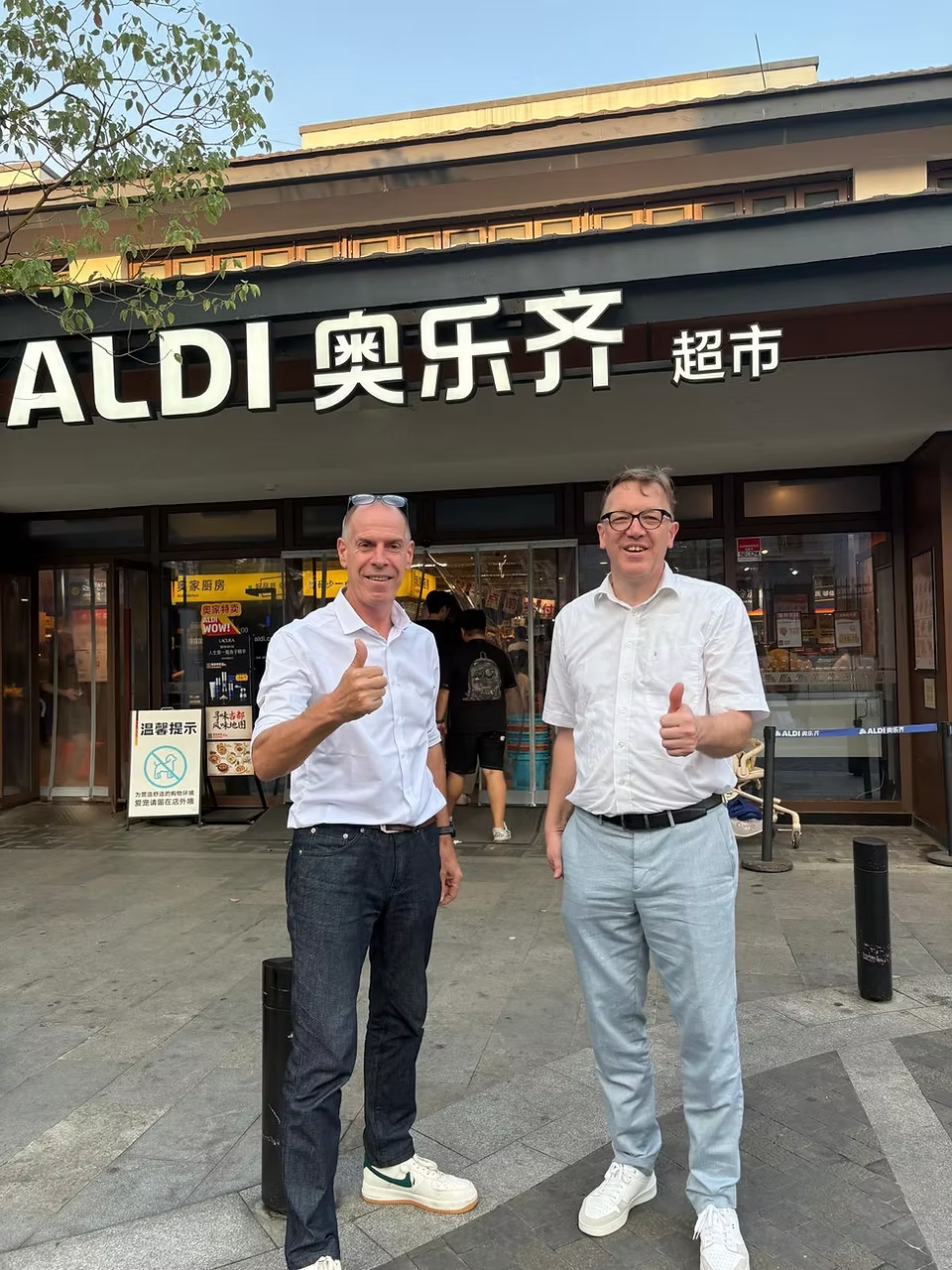
Aldi has in the recent years earned a meme-worthy nickname in China — the "Poor-Guy Supermarket." Yet, it is precisely this brand, jokingly labeled as "poor-guy," that is drawing increasingly long checkout lines and expanding steadily from Shanghai across the country.
"Poor Guy": From a Derogatory Term to a Badge of Honor for Youth
Let’s clarify the term "poor guy" (qióngguǐ) first.
Originally, it was an unflattering designation. But starting around 2023, things changed. As economic growth slowed, people began carefully managing their daily expenses. The "poor-guy" label gradually evolved from a mockery into self-deprecating humor—one that young people were even eager to embrace.
Unearthing a cheap yet pleasant supermarket or purchasing an affordable product with a great experience gives people enough joy to share multiple posts online. Being frugal is no longer shameful; knowing how to save and hunt for bargains has become a praised survival skill.
Aldi caught this exact momentum. Capitalizing on the trend, it adjusted its positioning and rolled out a clear slogan—"Good Quality, Low Enough Price"—openly putting "affordability" front and center.
Low Prices Aren't Built on Burning Money
Many wonder: How can it sell so cheaply and still stay in business?
The secret lies in its business model.
The first key is private labels. Over 90% of the products in Aldi stores are in-house brands. According to reports from The Paper and Gelonghui, Aldi has developed 13 private label lines in China. These include the entry-level "Value" series focused on ultimate cost performance, "Gu Yue Ren Jia" targeting organic and healthy foods, and "You Bai" for personal care.
What does this mean?
It doesn't need to be squeezed by major brand suppliers or bound by shelf fees like traditional supermarkets, nor does it pay for layered brand markups. The goods are self-sourced, the prices are self-set, and middle layers are cut to a minimum.
The second key is a "lean and curated" selection. Aldi operates approximately 1,800 to 2,000 SKUs in China, with about 1,500 covering daily essentials. It intentionally avoids giving customers too many choices—offering only a few options per category to concentrate high-frequency demand onto core items. Repeat purchases drive order scale, which in turn dilutes unit costs.
Leveraging a limited range of items to command massive procurement volumes naturally drives down costs. This is the essence of "hard discount": it isn't just selling cheaper; it is structurally cheaper than competitors.
A Hidden "Three-Tiered Tower" Strategy
Being cheap does not mean indiscriminate price slashing. Aldi’s shelves are structured into three distinct layers:
Bottom Tier: Driven by the "Value" series and fresh produce to pull in foot traffic. The white-packaged "Value" line contains over 200 basic daily necessities, mostly priced under 10 yuan. Supply chain insiders reveal that some items are sold at just 1 yuan above wholesale cost. While it looks like a low-margin strategy, it firmly establishes the most price-sensitive anchors to attract shoppers into the store.
Middle Tier: Balances profit margins through snacks, housewares, and general merchandise, encouraging customers to buy a little beyond their immediate essential needs.
Top Tier: Ready-to-eat and ready-to-heat foods anchor overall profitability, accounting for over 30% of total store merchandise.
This strategy—using low prices to attract traffic, mid-tier goods to balance, and high-tier products to profit—ensures that low prices and profitability are not mutually exclusive. That’s why many shoppers end up with overflowing carts despite entering for just a few items.
No Membership Fees, Yet Irresistible
Aldi also does something highly counterintuitive: it charges no membership fees. While Sam’s Club and Costco build barriers and loyalty through paid memberships, Aldi keeps its doors wide open. Anyone can enter and shop, with equal pricing for all. It bets on one thing: "Price itself retains customers."
In China, this tactic has proven remarkably effective. Consumers don't need to spend hundreds of yuan upfront for a card to access genuinely low prices; when the shopping experience is rewarding, they naturally return. It relies on an "efficiency-based trust"—skipping gimmicks and delivering daily low prices that earn voluntary repeat visits.
On Xiaohongshu (RED), posts about "Aldi Must-Buy Lists" are endless. Fresh milk, German beer, chocolates, and potato chips—users voluntarily endorse and spread the word for these high-quality, low-priced products. This organic word-of-mouth marketing works better than any paid advertisement.
Expanding Nationwide from Shanghai
Aldi entered China in 2019, operating almost exclusively in Shanghai for its first few years. These six years were spent quietly refining its model in Shanghai—a process locally dubbed "sharpening the blade."
Starting in 2025, its expansion accelerated significantly. According to reports by 36Kr and Nanfang Daily, Aldi’s China sales reached approximately 4 billion yuan in 2025, doubling its 2024 total of roughly 2 billion yuan. Its store network grew from 88 at the end of 2025 to 100 in March 2026, and currently exceeds 130 locations. Aldi China CEO Roman Rasinger (Chen Jia) announced that the brand will add over 50 stores throughout 2026, maintaining an average annual store growth rate of 40%.
In August, Aldi entered Nantong, Jiangsu, opening two stores simultaneously. Its Zhejiang debut is also finalized, with plans to roll out 11 stores at once in Hangzhou in early 2027—skipping single-store pilots to achieve immediate citywide density. Expansions into Anhui and additional regional markets are also underway.
Interestingly, this expansion was accompanied by a brief episode in 2025 when Aldi faced a lawsuit from Shiseido. Ultimately, the controversy only boosted its popularity, as public attention brought traffic, curiosity, and increased sales.
To evaluate Aldi's performance, it has gotten three key things right:
First, it turned "low prices" from a slogan into a structural model using private labels and curated SKUs. This is its core strength and the hardest part for competitors to replicate.
Second, it tapped into the modern consumer mindset. The transition of "poor guy" from an insult to a badge of youth self-deprecation reflects a fundamental shift in consumer psychology: people no longer pay for prestige; they pay for real value. Aldi sits directly at the center of this transition.
Third, it unified quality and low prices. Low prices alone cannot retain customers, while quality without affordability falls short. Aldi proves that both can coexist, forming the ultimate foundation for why a "poor-guy supermarket" can go viral and expand successfully.
However, Aldi shouldn't be overly mythologized. The 90% private-label model works seamlessly in mature markets where it has operated for decades; whether it can maintain long-term success across China depends on whether its supply chain, quality control, and localization can keep pace with rapid expansion. Meanwhile, its competitors are actively adapting—Hema is discounting, Yonghui is restructuring, and major players are adopting the "hard discount" playbook. Aldi is moving fast, but the road ahead remains highly competitive.
Still, Aldi as a German supermarket that leveraged "low prices" to transform from a mocked "poor-guy supermarket" into China's go-to "king of value" is, in itself, a compelling business case.
Ultimately, consumer needs haven't changed—what changed is how people allocate their resources. When consumers begin to carefully calculate every yuan, the supermarket that lets them "save happily and buy with confidence" naturally wins. And Aldi happens to understand this better than most.


Comments